Friday, May 22, 2015

Jeskai Tokens

I've had this deck running around in my head for months now, and I need to disgorge these thoughts before they drive me crazy(ier).

Spot removal these days is very common.  People are playing Hero's Downfall, Silence the Believers, Abzan Charm, and the like (various 3+ CC "kill target creature" spells), as well as the obvious 2cc choices of ultimate price, lightning strike, wild slash, and the like, to "deal with" the mono red deck, and other creature decks (which often cast a 3/3 for 2 of some type).

The other end of this spectrum is the mono-red deck, which goes all in on x/1's, and has the same removal suite of small single target burn spells.

What is good against both of these philosophies?  Tokens.


 =============>


==============>


Token Makers:

So, what are our options for making tokens these days?  There are four big players:


We have two good two-drops, a three-drop, and a x-drop, that all have pretty good rates on them.  Hordeling Outburst is the "best", and the one seeing the most constructed play.  Adding a mana and getting another 1/1 is generally a good deal, so this is the best option for raw power level.

Raise the Alarm is the best two-drop for the deck, it is an instant, so we can play it at the end of turn, hold up other spells (or the threat of them), and keep our opponent on their toes a bit.  Dragon Fodder rounds out the two-drop "creatures", and ensures that we can get out of the gates at a non-glacial pace.

Secure the Wastes is just a good card at any X above 2, and is not horrific at 2.  It's a late-game hedge, and a early game filler card.  It's _also_ a different creature type, for what is most likely our nemesis game 1:
Bile Blight is a card that can 1:1 us, but at least it probably won't be 2:1'ing us, and with control decks getting more greedy on the mana, and with three different creature types among our tokens, we can't get _too_ blown out by this main-deck.

Finally, we have one more just generally awesome card:
This is the 17th "creature" for the deck, and is very versitile.  If your opponent is going big on you, it can sweep their board.  If they're going small, you can match their volume, and many decks just can't beat this card.  It does give the enemy a target for Heros Downfall that is okay for them (we still get the tokens), but it's a okay secondary angle to attack from.  We won't overdo it with this, since it is a 6-drop, but we can afford one most likely.

Alot of token decks use these two cards as a second line of attack, but I don't think they are a very good idea main-deck.  The opponent has no good ways to use their little kill spells, or big kill spells, but these cards give them a reasonable outlet for their mana, and card efficiency.


           NO!


We don't really want to play God's Willing to save our Mentors, because it doesn't save us from their wraths, we have to have mana open.  We're even going so far as not including one of the biggest threats in the format:
We can pull cards like these in from the sideboard as part of a transformational plan, if our opponent is strong against our 1/1s, or has weak removal for such potent threats, but that is generally not the case, especially in game ones.

Where's the Beef?

So, we have all these little dudes, what's the payoff though?  If we have a 1/1 token, and they play basically any creature, they can block pretty profitably, and chump attacking one of my guys away to get a little damage in is not the kind of card advantage we want to see from getting our "2:1" by casting Dragon Fodder.

We might have thought playing a honest-to-goodness creature is worthwhile in a deck like this, but this is one real engine that rewards us for not playing actual "summon" spells, but rather instants and sorceries that summon tokens instead.  It's all well and good to devalue the opponent's removal, but when we start casting our second "creature" and buffing all of our other tokens, while triggering a draw-discard ("loot"), we start seeing why we might not want J. Random Creature in our deck.

This card has all sorts of synergies with just the cards we've covered so far:
1) They all trigger a loot when you cast them (unlike a creature)
2) They get multi-buffed by any other non-creatures you cast
3) They are non-creature spells, so they buff your other tokens when you cast them

But we'll see as we go along that this is just the beginning of the possibilities with this card.  We'll talk about them more in the later sections.


Elspeth's ultimate ability (+2/+2 to all your creatures) is a great buff for your overall strategy if your opponent cannot interact with what she's doing, but there are a few other cards that pay you off for having a bunch of individual 1/1's, that I'd classify more as "one-ofs" than "four-ofs", and they are:


I think both of these cards are exceptional one-ofs.  They are legendary, so you don't want to draw two of either, and both of them really pay you off for having a bunch of little guys, either by letting you draw a bunch of cards, or by making them bigger.  They make your instant guys into huge threats, they're non-creature spells that stick around (and are both sticks), can be drawn before or after your creatures to good effect, and both have a secondary ability that is not terrible (and people likely have no idea that they exist)


Both of these enchantments also dramatically increase the threat that having two tokens in play (a minimum investment) represents on your side of the board.  Military Intelligence is a super-cheap spell that can get some card volume into your hand (so you can loot away the worst).  Dictate is a super-big threat, that adds to your instant-speed plays, either as a combat trick, or to sneak it in while your control opponent is tapped out, to make everything else you do must-answer.

I would rather have one of each of these, than four of any one.  The variety of casting costs, and effects, is much better than having two of any one of them.  It's possible that we should play more than one copy of some of these, but for the time being, I'd start with having one of each.

Also, I'd like to state here that having raw card drawing is very important when paired with Jeskai Ascendancy.  If you have one card in your hand, or even two, having every spell you cast let you draw and discard is not very exciting.  You may already have two good cards in your hand, or just one, and you don't get much value out of it.  But if you draw an extra card or two, you suddenly have a few cards that aren't what you're looking for, or just an extra land or two, that you can easily decide to discard in favor of another random card.

Every extra random card you draw greatly empowers your future loots, no matter what it is.
It's also really important, as well as cool, that every spell we cast lets us loot with Ascendancy, which makes any of them that draw cards that much more powerful.  Seeker of the way is powerful, but it's not great late, and doesn't really do anything, nor does it at least trigger a loot to get rid of some of our other dead draws late (a bunch of extra land).

We can't overdo it with +1/+1 effects ("anthems"), but having a couple of the most powerful ones, or are multifunctional, sounds pretty awesome.   (We want "action" to draw into, and not just have a board of pump effects and lands)

Other Spells

I don't know if you've considered a pattern of the above cards we've talked about, but Delve is a fantastic synergy with basically all of them.

All of our "creatures" put a card in the graveyard on resolution. (cutting a mana off the Cruise)
Jeskai Ascendancy loots with every spell we cast, fueling up our graveyard without even having to cast the spells.
Our card drawing and pump effects either are winning us the game (by drawing cards or pumping our guys), or have been killed and are reducing our costs here.

The other busted draw option is:
I think this is a solid card, but there are a couple things I don't like quite as much about it:
1) It costs double-blue.  Blue is our splash color, because we have so many white and red mana symbols, and double-white and double-red at some levels.
2) It always costs two mana.  I expect the colorless portion of the delve spells to be near-zero here, and we can't make this spell cost one if we need it to.
3) It only gives us two cards instead of three.  Having an extra card is very important when we're looting non-stop, for reasons above.

Now, objectively, Dig has some advantages, and may be a superior card:
A) It finds specific cards better.  Like Ascendancy so we can start looting for example.
B) It finds better cards.  We'll have probably one good and one average-or-better card after casting this spell, where we'll have a land, a average card, and another card after casting cruise.
C) It's an instant.  We have several instants in the deck already, and instants can be combat tricks in this deck.
D) You can wait to cast this until you know what you need at the end of your opponent's turn.

I'm not sure at this point which of these is "better".  I think you could have a mix, but I'm probably starting with 4x Cruise, or 3xCruise/1xDig for the reasons stated above.

Lighting Bolt is a pretty good card.  Too good for standard.  How about if it did one more damage, and cost zero mana instead of one, would that be good?  Clearly....

This card is a reason why Dragon Fodder is a comparable card to Raise the Alarm, even though Raise seems clearly superior on it's face:  it's an instant, a different creature type to Hordeling Outburst, etc...  The bonus is that red goblins tap for the "R" in the casting cost of Stoke the Flames, not just the "2", which can cause this spell to be free instead of costing "RR" (still a great deal, admittedly).

Hordeling Outburst is absolutely absurd with this card also, especially on turn four.  Tap 1RR, cast Hordeling Outburst.  Tap the three goblins, and your remaining mana to convoke out your Stoke the Flames, killing one of their big guys, looting (again) with Ascendancy, etc.

Stoke is super powerful with these tokens, because often you can't attack with the creatures anyway, either on their end-of-turn, or utilizing your summoning sick guys. When your 1/1 guys that cost you (often less than) half a card, and get double-pumped by spells with Ascendancy, also tap for mana, things start to get crazy.

Having a "free" burn spell is an awesome removal spell in a deck like this.  We need some interaction, we need to remove blockers, or threats.  We might need to get some damage to the face in to close a game out, and 4 is a massive number.

The Rest?

We have between 2 and 4 "slots" assuming we want to play 24 lands (we may want more land), so we have some room to play some random stuff.  I would expect these spells to be additional "interaction" spells with your opponent, and we have a ton of options to play with.


 There are a few things we want out of our spell:
1) That it is a non-creature spell.  We don't want to open ourselves up to creature removal main-deck.  We want to trigger our Ascendancy.
2) We want it to not be dead.  We want to be able to cast our spell, have it do something, and move on with our life.  Wild Slash is not the best in this scenario, because there are decks with creatures, where Wild Slash doesn't kill their threats.  Lightning Strike seems better in most cases, because we'd rather do one more damage if we're going to the face, and we have the little guys taken care of to some extent.
3) We want this spell to do something we care about, really answer a problem that we need answered.
4) We want it to be cheap.  Things we can cast early, or while leaving up just a mana or two are very important.

I would say Negate, Disdainful Stroke, Anticipate, and Lightning Strike are the front-runners.

Problems we'll face:


Since all but one of these is a non-creature spell, I would say Negate is perhaps the best answer.  Disdainful Stroke is commonly played as a general-purpose answer to scary stuff other people do, but it doesn't answer the cheap stuff, and doesn't answer the cheap creatures.

I like that negate counters all the sweepers, and counters their ways of interacting with our enchantment(s).  It doesn't deal with Siege Rhino, or Ojutai, but hopefully we can end of turn something big, and punish them with an enchantment on our turn.

Lands:


Taplands are an important part of standard these days.  These are our "one drops", helping us be able to cast our spells (giving us the right mana symbols), and doing some scrying to "smooth things out."


We need lands that come into play untapped our deck.  We have to start casting spells on turn two, and these fix our mana, and Flooded Strand helps enable our delve spells.  We might include one Evolving wilds, or Mana Confluence, to help our mana (we have double-red, double-blue, and double-white costs in our spells)

The reason we're using the RW painland and RW temples to the max is because we have UW fixing from Flooded Strand, and we have the most Red and White mana symbols in our deck. (16-24 red depending on how you count stoke, 20 white, and just 12 blue before the 2-5 "flex slots" are considered)

V1 of this deck:

Tokens:
4x Dragon Fodder (1R)
4x Raise the Alarm (1W)
4x Hordeling Outburst (1RR)
4x Secure the Wastes (XW)
1x Elspeth, Sun's Champion (4WW)

Pump:
4x Jeskai Ascendancy (UWR)
1x Spear of Heliod (1WW)
1x Dictate of Heliod (3WW)

Draw:
1x Bident of Thassa (2UU)
1x Military Intelligence (1U)
4x Treasure Cruise (7U, Delve)

Removal:
4x Stoke the Flames (2RR - Convoke 4 damage instant)
3x Some Interaction

Lands:4x Mystic Monastery (UWR tap)
4x Temple of Triumph (WR tap, scry)
2x Temple of Epiphany (UR tap, scry)
4x Flooded Strand (UW Fetch)
4x Battlefield Forge (RW Pain)
2x Island
2x Plains
1x Mountain
1x Evolving Wilds

Sideboard:

One of the reasons I like this deck is that people have a ton of terrible cards in their main-deck against you.

The sideboard is something that can really change what your deck is doing, and you can do it in a ton of ways:

Plan Alpha: Beat Creature Decks:

Does this sound like a fun plan against guys with creature swarms?  We deploy our enchantments, sweep them up, deploy our instant creatures, and go to town.  Dragon Fodder likely comes out in this scenario.

Plan Beta: Beat -x/-x effects. (Control)

These guys have the magic 4 toughness to beat all the sweepers before 5cc. 

Plan Gamma: Vs no removal
Good early, good late.  Can take over a game by themselves.  These aren't as good against -x/-x sweepers, but might be reasonable against big dumb green decks.

We probably can't do all of these, but we have a core to this deck that can take many different shells.  I think the tokens are the best for Game One, but post-sideboard, we can enable most anything we'd want to try and do, depending on what our enemy can try to answer our main-deck strategy with....

Wednesday, September 25, 2013

Theros - Gods - BLUE!

Editor's note:
From the Theros FAQ:
http://www.wizards.com/magic/magazine/article.aspx?x=mtg/faq/ths
Hybrid mana symbols, monocolored hybrid mana symbols, and Phyrexian mana symbols DO count toward your devotion to their color(s).


The second mechanic from Theros that really gets me excited is Devotion, because it's a mechanic I've thought about long before the release of Theros, and it makes me want to do strange things like try to break the mechanic by utilizing permanents that do not suffer from the major disadvantage of the mechanic (flooding the board, and getting destroyed by "sweeper" effects like Mutilate or Supreme Verdict)

We can work around this by utilizing enchantments, planeswalkers, artifacts, which will stick around after those effects.  We can also use powerful creatures like Boros Reckoner, Burning Tree Emissary, or  Nightveil Spectre, which can actually go in quite a few color combinations, and get us 75% of the way there for god-activating purposes. (require 5 devotion, but all come with one symbol already)

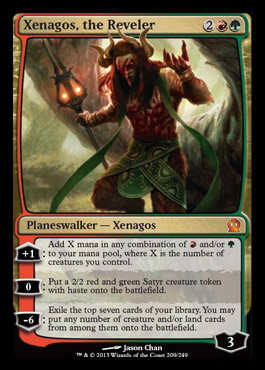
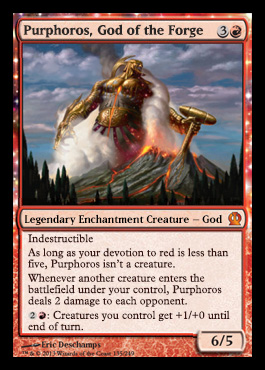
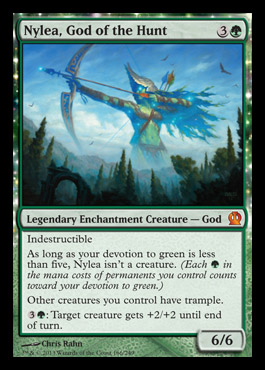
The easiest gods to activate are the red and green ones, because in those decks, you will almost by definition have more creatures as part of your normal strategy.


This is all well and good, but these gods aren't all that exciting to me.  They cost 4, and their stats aren't that impressive.  Heck, you could just cast a 5/5 for 4 any number of ways these days, and their abilities aren't that exciting.  They help prevent flood, but I'd rather be powering in to more and more creatures (to ensure these guys are turned on.  Both of the static abilities are good, but in general require follow-up to be effective.  (The creatures that matter to give trample are cast after Nylea (who doesn't give herself trample), and the creatures most effective to be cast after Purphoros are your little guys, which you've already cast.

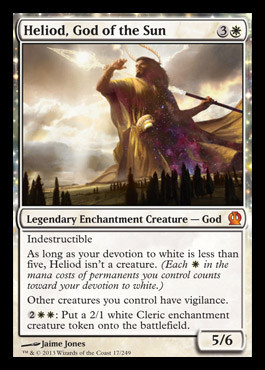
In general, people are pretty excited about the White god:

But most of the shells I see him put into have no way of activating his devotion.  He's just a creature factory.  8 mana for a 2/1 is not exactly a great deal (and the tokens don't turn the god on, which is flavor fail to me).  Now, to be sure, this is a quite reasonable activated ability, that doesn't overextend you card-wise (though surely tempo-wise with the large mana investment)

Granting vigilance with the only creatures in your deck being tokens or token generators (you likely have the new Elspeth in this deck too) is not too exciting, so this mostly counts as a creature generator, not a creature pumper.

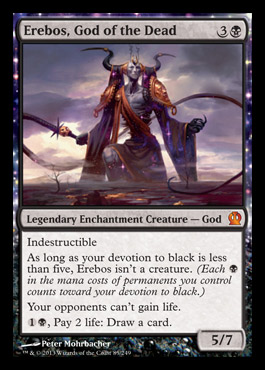
The black god is also getting some press:
Black is set up the most to turn on devotion well, with various black-intensive enchantments that would work well to activate Erebos.  However, his abilities don't exactly keep you alive, nor do said enchantments like Dark Prophecy or Underworld Connections.   You have a reasonable shot at just being run over by an aggressive deck before this guy (or your other enchantments) even matter, so I'm a bit skeptical that he does enough.  He's also representing the only color whose god + weapon BOTH cost 4 (and neither is particularly speedy)

Overall, he just seems too slow.

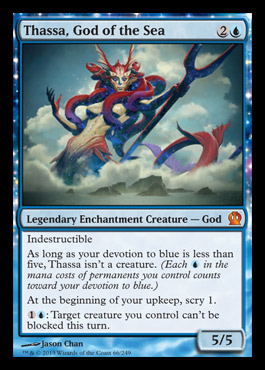
The god I'm most excited about at this point is actually the blue one
Thassa has several advantages over the other gods:
1) She's the cheapest.  You could be swinging with her, before the other gods are even awake (turn 4)
2) Her stats are really incredible for her casting cost.  5/5 for 3 is way better than +1 to power or toughness on that for +1 mana.
3) Her static ability is going to be relevant even if you have NOTHING ELSE going on (the worst case scenario).
4) Her static has the highest chance of turning herself on. None of the other god's static abilities do anything at all to help activate them.
5) Her static is one of the best for an aggressive-minded deck, because it lets you play lands to hit your drops, without being flooded late-game.  Aggressive decks are probably the best place for gods, because it's the easiest way to turn them on.
6) Her activated ability means she's the only god here who can actually do damage against an opposing board presence (god or no god)
7) Her activated ability is also the best to target herself with.
8) Her activated ability does the best with "saboteur" creatures (on combat damage to opponent), which tend to be pretty strong, especially in blue, if you can get them through.
9) Her static is the best way to get rid of more copies of herself (by not drawing them), which is a problem for these relatively hard-to-deal-with cards.

So, what are the questions Thassa poses to us?

How do we turn her on?
The Theros set itself is pretty god-awful for turning Thassa on.  It has few double-colored creatures, few enchantments that you'd want to play.  It mainly has a bunch of spells (which do nothing for devotion), a bunch of terrible 4-drops, and a few monstrous creatures (which don't combo very well with activating Thassa, since you spend a bunch of mana but don't increase your blue count).  Thassa will help you find your mana to turn these huge drops on, but that's not that exciting.

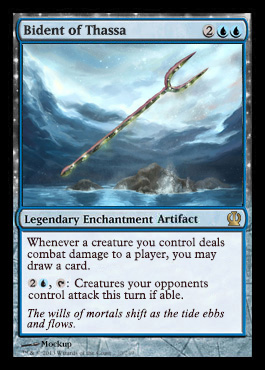
Thassa's weapon does work pretty well with her.  It does a pretty good job of turning her on (3drop Thassa into 4drop Bident, into attack on turn 4 if you have two other devotion).  This puts the opponent into chump-block mode as early as turn 4, and on later turns, Thassa's activated ability won't let them chump.

However, thankfully, we aren't just reliant on this single set to find good permanents, we just came out of a block that was very color-intensive, and also thankfully, very hybrid-color-intensive.

The easy part, creatures:


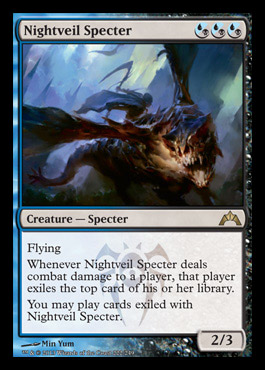
Nightveil Specter is a pretty awesome creature.  It has evasion, it doesn't cost too much, and it provides a ton of devotion towards swinging with your Thassa.  It also means you're likely to have some lands to activate Thassa's ability, to get the Specter through in future turns.  This is an easy four-of.

Frostburn Weird is another exceptional creature.  It's very difficult to kill, and it has a ton of stat for it's cost, especially for a blue creature.  Unblockability is another solid feature for this creature, who holds the fort for you, then starts swinging for 4 a turn.  Not bad at all for a 2-drop.  I'd play eight if I could.

Unfortunately, that's where the love for playable omni-color hybrid stops.

It's important to remember that including these two creatures in our deck commits us NOT AT ALL to playing either red or black.  Dimir Guildgate doesn't help cast Nightveil Specter more than Basic Island, or Azorious (UW) Guildgate for that matter.  All it means is that we won't be playing any basic lands of any splash color we might have.  As long as those lands tap for blue, we're good to go to cast either of these spells.

The hard part, non-creatures:
We've already mentioned the Bident above, but that's not a card you can play four of, or probably even three, because it's legendary and doesn't do anything on it's own.  So where else can we find sources of non-creature devotion?
Claustrophobia is a good way to lock down a problematic creature, or even god with enough devotion.  Three is about the limit to pay for this kind of effect, and it will stick around unless your opponent kills their own creature off.  This doesn't work well against wrath effects, but it does lock their guy down, and that's about as much as you can expect out of blue removal.  Three is probably as many as you'd want of this type of thing main-deck.

These really are the best options we have for turning Thassa on, and they all work pretty darn well, without over-committing ourselves to the current board state.

How do we be aggressive with her?
We've talked about how we want to be aggressive with Thassa.  We want to have creatures in play to make unblockable, and we want to turn her on ASAP so we can start smashing for 5 and scrying lands we don't need to the bottom.

So we need some early creatures, to beef up our offense, and add to our early devotion.


I'm excited to play with Cloudfin Raptor.  It has the potential to get huge in our deck already, with Frostburn Weird and Nightveil Spectre, as well as most any other creature we'd play, pumping it up into the two power range, which is where we need to be.

Judge's Familiar I was less excited about, but we really need low drops, and gatherer searches for one drop blue creatures comes up VERY short.  The best you can hope for is really a 1/1 flyer with an ability, and Judge's Familiar has a better ability than Winged Sliver, or the Izzet creatures (which want you to play a bunch of spells, not creatures, for marginal effect.  It'd also be possible to minimize the Judge's Familiar presence, and just rely more on our two-drops.

I wish Faerie Imposter could bounce itself, because that would make for some awesome turn 2's with Cloudfin Raptor, but that's not to be.  (And this deck doesn't have much in the way of comes-into-play for the Imposter to reuse)


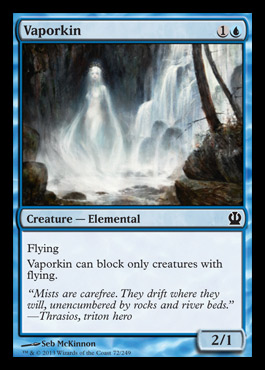
In the mono-blue realm, we have Vaporkin, and the sideboard card Tidebinder Mage.  Vaporkin has evasion, which is what we're looking for.  Tidebinder Mage is going to be awesome out of the sideboard.

If we consider Green as our splash (Remember, Simic Guildgate casts Frostburn Weird and Nightveil Specter just fine), we get the potential for Frilled Oculus and Zamec Guildmage.

I really like Frilled Oculus, because it's going to evolve Cloudfin just like any 2-power creature.  It's cast-able without your splash, and it can use your extra mana at quite a good rate to do some damage.  It's also pretty awesome at blocking early, which, along with Frostburn Weird, gives us a pretty solid lock-down on opposing aggressive decks.

Zamec Guildmage is a fine one-of, but I wouldn't go much past that.  I don't think we'll reliably have untapped Green on turn 2, or enough green to activate it's abilities too many times to warrant playing more of him, but he's great flood-mitigation.  He also helps your 1-drops be less dead if you have them after your opening hand, or if they get bounced, etc.

Three-drops are a bit lacking for blue, but that's where we're dropping Thassa to hedge wrath, Claustrophobia to clear away a blocker, or Spectre to deploy a strong threat.

There really aren't any strong mono-blue options, but perhaps Beetleform Mage, Drakewing Krasis, or Elusive Krasis are worth investigating.  I don't like having a Green three-drop though, because having untapped green on turn 3 is hard with our extensive 2-drop collection.  Having it on 4 is quite a bit easier...

How do we have a late game?
Thassa's Scry helps us still be drawing good stuff late, but we don't want to be totally dead if the game goes to turn 6, or if we don't have Thassa (she is legendary after all).

So what can we do about that?


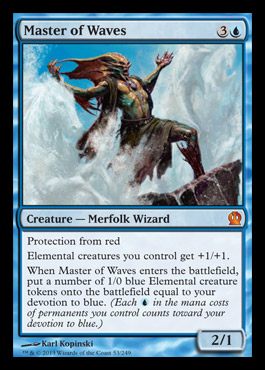
Speaking of Green on four, and speaking of ways to make your one-drops better late-game, Master Biomancer is a card that can get pretty crazy.  Speaking of ways to make Master Biomancer crazy, take a look at Master of Waves.

Master of Waves pays you off for your devotion to Blue, and randomly is awesome against Red.

Master Biomancer is also pretty solid if it get's going.  It's also possible that since we're providing some solid pressure from our early creatures, the enemy may be out of their targetted removal by the time this guy hits the board (post-wrath likely)

Neither of these turn on Thassa particularly well, but Water Servant and Archeomancer may be the only 4-drop creatures that have a double-blue casting cost left in the format, and neither of those are exactly constructed powerhouses.

Both of these are good in multiples (second Biomancer gets insane, second MoWaves keeps the other's elementals alive if the first is killed...), and with each other, but they are both four-drops, so we can't go too crazy here, especially if we include a Bident or two as wrath-protection.

Vaporkin is also an elemental, for what that's worth (almost nothing)

How do we not get destroyed by wraths?
Thassa and Bident help a bit here, but these are legendary permanents, so we can't over-commit in deck-space there as well.  Claustrophobia helps us get devotion without creatures


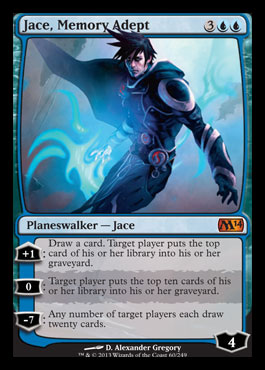
Jace 5 seems pretty darn awesome against "control decks" sporting these wraths, and gives us a way to quickly close out the game against them.  We also have a metric ton of creatures to block with to keep his "0" grinding our opponent to insanity..  Jace AoT is less intriguing for an aggro deck, but is a bit cheaper.

I don't know how many if any of these should be main-deck, since they don't go with the main game-plan of the deck, but they could be strong out of the sideboard.

This is the last piece of technology I've been considering.  It seems strange, but equipment right now is absolutely terrible.  The Saber however, does a pretty passable Bonesplitter impression in this deck.  It is a one-drop, so it fills in our curve, and is Rancor-like, in that it gives us evasive power (more because our creatures are evasive than due to trample), and doesn't walk us into wrath effects.

Do we want any spells?

We're playing some evolve guys, and have a partial devotion strategy, so having non-creatures is a real cost in our deck.
We also have a ton of mana-sinks to turn our excess lands into damage to our opponent.  This makes "holding up counters" pretty awkward.
We also have a fair chunk of evasion already, so bounce cards like Cyclonic Rift are good for racing, but don't help our guys get through as much as just turning them sideways does.


Mizzium Skin does quite a bit, for a very low cost (1, or maybe 2 mana).  A card like Dispel or Negate might be conditionally better against sacrifice effects, planeswalkers, or (non-Supreme Verdict) sweepers, which is a real consideration, but Mizzium Skin seems like it wins the "efficiency" race, allowing us to develop our board on any turn before turn 6 or so, without having to commit to leaving mana up to protect our guys.

I think having up to 4 of this kind of effect is going to be pretty strong.  It won't dilute our strategy too much, and give us some protection.  Whether this is in the main or side, or how many we play is an issue up for discussion. (Also, the Judge's Familiar count could impact this)

So, a decklist?

Creatures: 26
4x Cloudfin Raptor
2x Judge's Familiar
4x Frostburn Wierd
4x Frilled Oculus
1x Zamec Guildmage
4x Nightveil Specter
3x Master Biomancer3x Master of Waves

Thassas: 4
4x Thassa

Permanents: 5
2x Claustrophobia
2x Civic Saber
1x Bident of Thassa

Spells: 2
1x Mizzium Skin
1x Negate

Lands: 24
4x Simic Guildgate
4x Temple of Mystery
4x Breeding Pool
12x Island

Sideboard:
Tidebinder Mages (R/G)
Jace, Memory Adepts (Sweepers)
Master of Waves (R)
Negate/Mizz Skin (Control, targetted removal)
Sensory Deprivation?  (Aggro)
(Needs work)

Mana curve:
1: 9
2: 10
3: 10
4: 7


I want more of all the non-creatures, but I don't know if I can afford it.

Getting excited about Theros. (Ember Swallower)

So, it's been a while (only 6 months!), but with new sets going out, it certainly gets the creative juices flowing.

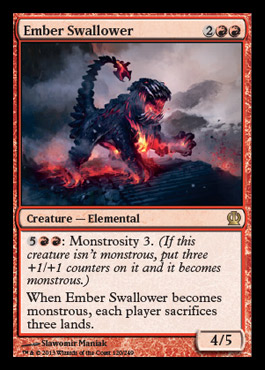
The first mechanic from Theros I'm interested in is Monstrous.  Or more particularly, one specific monstrous card
This card makes me really excited.  The base rate on this creature is pretty good, with power equal to it's casting cost, and a toughness that survives any sort of damage-based removal.  This particular implementation of the Monstrous mechanic that on it's face is symmetrical, but in actually, it is anything but.  You get to build your deck with it in mind, with mana acceleration from Xenagos, or mana creatures (which also work well together to get the 4-drops out faster, and power you up to 7 mana)


Turn 3 Xenagos, Turn 4 Ember Swallower, Turn 5 Activate Ember Swallower is something we can do with only 3 land, Xenagos, any mana creature, and Ember Swallower.  We can even sustain the loss of one of the satyrs with just drawing a 4th land.

Wrath against that board position (turn 4, or never after they lose 3 lands) is not even that devastating, because you still have Xenagos, who'll be ready to punch them in the face the next turn, or accelerate out other monstrous threats.


I'll have to think about this a bit more before I put out a full decklist, because there is a certain amount of conflict between the cards.  You want a lot of creatures, but you don't want to die to wrath effects.  You will have a ton of mana, but you want to have action even if things aren't operating at full power (a reason I like Monstrosity so much, you can run it out earlier)

4x Mizzium Mortars (We have a board presence, so it works well, and we'll have the 6 mana)

4x Xenagos

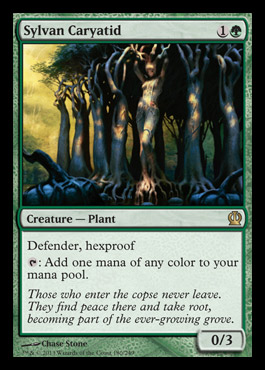
4x Sylvan Caryatid
4x ZurTa Druid/Gyre Sage

4x Ember Swallower
4x Kalonian Hydra

Red Hammer?
Some huge green creatures or planeswalkers?

12x RG dual lands (shock, tap, scry - CIPT is not a huge downside, since we'll primarily have 2 drops over 1 drops)
12-16 basic forest/mountain


Friday, April 5, 2013

Example Winchester Draft part 2: Deckbuilding and play

So, this post we'll be taking a look at the deckbuilding and gameplay from the Winchester (2-player) draft format from the previous post.

Player A from the last draft ended up with a fairly solid Green-White-Black ("Junk") deck with strong mana fixing, and some reasonably sized creatures.

Player B ended up with a Red-Blue (Black) ("Grixis") deck, with quite a few early creatures, and some early interactive spells.  Things didn't look good for player B if the game went late, because while they had card drawing, their creatures weren't the best.

Game 1:
Player A won the roll, and decided to play first.  They opened a hand of Ambition's Cost, Goblin Piker, Unsummon, and four blue-red lands.  This is playable, but they sent it back, to a one-lander, with a bunch of two drops, but in a three color deck, playing any of them might be problematic.  The Four card hand had a Child of Night (2/1 lifelink for 1B) and again all blue and red lands, but we basically had to keep it at that point.

Player B kept a hand with all three of his colors, Youthful Knight (2/1 first strike for 1W), Assault Griffin, and a Jayemdae Tome.


Player A's Youthful Knight, did a good job of holding off player B's little guys, due to his first strike.


Player A got his Child out on turn two thanks to a "lucky" draw of a Swamp off the top, but was left with no good options when Player B deployed their Youthful Knight.  Player B drew some more two-drops off the top, but the Youthful Knight held them all off, while an Assault Griffin beat down in the air for player A, and the Tome drew him more cards.

Player B did draw into some card drawing, which drew him into even more two-drops.  He eventually found a Blisterstick Shaman, which killed off the Youthful Knight and allowed an attack for 8 damage, but it just was not quite in time, and player A managed to fly  over for lethal the next turn.

Looks like the mulligans, and the good defensive creature were enough for player A to hold on for the win, all in all an inauspicious start for player B, to be sure.

Game 2:
Player A was on the play again, and started with a much better hand of Ambition's Cost, Goblin Raider (2/2 can't block for 1R), Aven Fisher (2/2 flyer for 3U), Unsummon, Volcanic Dragon (4/4 flyer with haste for 4RR), and all three of his colors.

Player B had only black and white lands, but had a Ravenous Rats (1/1 for 1B) to slow the early game down, a Centaur Courser (3/3 for 2G) a Tome, and a Siege Mastodon (3/5 for 4W) for later-game plays.

Player A led out with lands, and the Raider, while player B drew a Forest off the top, making his early game look significantly better with the Centaur on turn 3.  Player B drew some lands off the top, one of which was discarded to player A's Rats, and just developed his board with the Aven Fisher.

Player A liked his position, and drew some more big creatures off the top, so he started to attack with his Centaur, leaving behind the Rats, and a freshly-drawn-and-cast Roaring Primadox (4/4 for 3G with a "drawback") on defense.


 Yup, Roaring Primadox's "ability" is a "disadvantage"... more like an "engine"...


Player B drew a card, and just had to run out the Ambition's Cost, drawing three and losing three in the process, but the cards he drew would turn out to be pivotal:  A Island, a Flame Slash, and a 2-drop.  He had an Unsummon in his hand at the time, so he used the Island and the Unsummon to bounce the Roaring Primadox back to player A's hand, and attacked for 4.

Player A drew a land, so they played the Siege Mastodon, which should put the brakes on player B's attacks, and allow player A to continue to play out cards from their hand, without worrying about the Primadox's disadvantage for the time being.  This was rough for player B, since their Flame Slash does 4 damage for a single R, but the Mastodon has 5 toughness.

Knowing the Primadox was likely to show it's face again, player B swung for two in the air, dropped a Phyrexian Rager (drawing a card and losing a life), and followed up with a Dragon Fodder (generating two 1/1 goblins), but held off on using the Flame Slash on the Centaur, or to finish off the Mastodon.  Player B had 6 land in play at this time (drew a land off the Rager), so the Volcanic Dragon was about to come online...

Player A drew another land, making 6 total, and recast the Primadox, then attacked in with his two three-power guys.  Player B thought for a while, before throwing one of his goblin tokens under the bus for three life.


Player B had plenty of lands from all their draw spells, but needed to draw one more to do both of these in the same turn!


Player B tapped the top of his deck, and drew the land he needed to play both the Flame Slash on the defending Primadox, and to cast the Volcanic Dragon.  He sent in for 6 in the air, and 2 on the ground from his Goblin Raider (can't block), taking player A down to 4 (dead on the next turn without a removal spell), and even with a Glorious Anthem, player A couldn't muster the 5 damage he would need to kill player B through the few terrible creatures player B left back to block.  Player B sent his flyers over the top for the final 6 damage it would take to finish off player A.

Victory for player B!  Card drawing, and terrible, somewhat evasive creatures for the win this game...

Game Three:
This would be for all the jelly beans, and player B would have to win a game on the draw for the first time....

Player A kept a hand of Forest, Swamp, Plains, Sunpetal Grove (land, taps for G or W), Birds of Paradise, Primal Clay, and Smite the Monstrous (Player B's deck isn't overloaded with four power creatures, so this might not be the solid removal spell it typically is...)  Player A will need to draw some good-sized creatures to not get run over, but the Clay as wall or 3/3 should hold the fort for a while.

Player B keeps a hand of Island, Island, Swamp, Phyrexian Rager, Ambition's Cost (draw 3 lose 3 for 3B), along with a pair of uncastable red spells in Goblin Piker and Wave of Indifference.  Hopefully with a land or two, and so many draw steps, we'll find what we need to give player A the beating he so richly deserves...

Player As first few draw steps were quite good to him, providing a solid defender in the form of Bottle Gnomes, and a stalling creature in the form of Master Decoy.  Player A of course did not draw his fourth land until the 6th turn, developing his board with 2 power dorks for 2 and 3 mana, and getting in for some pathetic beats, enabled by his Squee's Toy.  (All of player A's creatures had 1 power, so he would have to trade off his Master Decoy in a double-block to kill even player B's pathetic Coral Merfolk (2/1 for 1U). 


Squee's Toy + Coral Merfolk, why don't we see more articles about this interaction =P


Player B didn't have much to play, and drew some more red spells, but eventually got his fourth land for Ambition's Cost (draw 3, lose 3, for 3B).  It of course, drew him no more lands, but he got some cheap interaction, with Unsummon, and Divination among the cards drawn.  He eventually started hitting some lands, and a Siege Mastodon being bounced, and a 3/3 Primal Clay being Flame Slashed destroyed player A's defensive board position, and allowed attacks for 2, 4, and 6 to head in.  The following turn, he unleashed a Wave of Indifference to get through even more damage!


 Sorry boss, I'm "busy"...


Amazingly, though player B had around 9 power in creatures, he had nothing with more than 4 power, so the Smite the Monstrous in player A's hand was not looking to smite-worthy.

Eventually player A drew some creatures, and Player B's beat down was halted, until a Essence Drain ensured that the Master Decoy would not hold off player B's Welkin Tern.  Player A of course top-decked a Feral Shadow (2/1 flyer for 2B) to hold it off instead.  Player B eventually drew a Blisterstick Shaman to kill the Feral Shadow, and the Welkin Tern beats commenced anew, with player A on a precariously low 5 life after the first swing.

Player B had only a Essence Scatter and a land in his hand, with 8 in play, but held off using it on a Borderland Ranger, since it would not prevent the Welkin Tern from beating down.


Bottle Gnomes are great on defense, but they couldn't keep up with the massed hordes from player B...


A turn or two later, player B drew a Volcanic Dragon, and sent everyone in.  Player A was glad to Smite the Monstrous Dragon, but still had to block with everything, and sacrifice his Bottle Gnomes before damage to just stay alive, leaving player B with ~5 creatures to player A's lonely Siege Mastodon.  With Essence Scatter in hand, player A had no outs.

Victory for the improbable player B, and a solid end to Winchester Draft 1!